Salt, Silence, and Surrender: Seven Family Meals That Left Bruises You Can't See
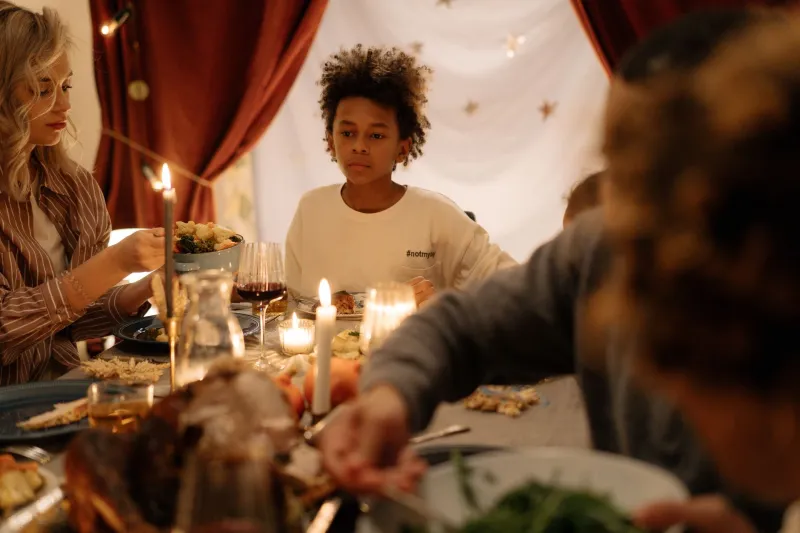
The dinner table is one of storytelling's most reliable stages for violence. Not the knife fight, not the gun under the napkin, but the quieter kind: the pause before a sentence, the smile that is really a warning, the meal that everyone attends because refusing would be its own confession. Food is supposed to be hospitality. In these scenes, it is a binding contract.
The most devastating family meals in film and television understand that violence does not require a raised voice. It requires a room where everyone has agreed to behave, and a secret that makes behaving impossible. Here are seven dinners where the plate is a battlefield and the salt is passed with something closer to surrender.
1. American Beauty (1999): The Plate as a Battlefield
Lester Burnham's family dinner is a masterpiece of passive aggression. Carolyn plays music that sounds like a commercial for a life no one is living. Jane sulks. Lester, newly awake to his own misery, refuses the script. The scene begins with manners and ends with a plate thrown against the wall. What makes it brutal is not the outburst but the years of politeness that preceded it. The table is where the family performs normalcy, and the performance is the violence.
2. Hereditary (2018): Grief at the Table
After the family's catastrophe, Annie gathers Peter and Steve for a meal that is less dinner than interrogation. The food is ordinary; the air is not. Annie's grief has become a weapon that she cannot put down, and Peter's silence is both defense and accusation. The scene is devastating because no one is allowed to leave. The table becomes a closed system where mourning, blame, and love are passed around like dishes no one wants.
3. The Bear, Fishes (2023): The Controlled Explosion
On its surface, the Seven Fishes dinner is anything but quiet. It is chaos, noise, and escalating cruelty. But that is precisely why it belongs here: the episode shows the family table as a pressure cooker where every joke is a jab and every kindness is a debt. The meal is a ritual that promises togetherness and delivers a reckoning. By the time the tension breaks, the audience understands that the loudest violence was built out of smaller, quieter failures.
4. Succession, This Is Not for Tears (2019): The Power Auction
Aboard the family yacht, a meal becomes a tribunal. Logan needs someone to carry the blame for the company's sins, and the dinner table is where affection is converted into liability. No one throws a punch. No one has to. The violence is in the way a father can make his children compete for the privilege of being sacrificed. The food is irrelevant. The seating is everything. The scene works because it understands that power is most terrifying when it is served with courtesy.
5. Festen (1998): The Toast as a Confession
In Thomas Vinterberg's film, a family gathers for a patriarch's birthday dinner, and a son gives a toast that turns the celebration into an accusation. The table does not explode at once. It freezes. The ritual of the meal—the speeches, the applause, the forced smiles—becomes a cage. The violence is in the exposure, and the most disturbing part is how the family tries to keep eating. The scene proves that a dinner can be a courtroom, and that a toast can be a verdict.
6. August: Osage County (2013): The Funeral Meal
After a funeral, the Weston family sits down to eat, and the matriarch, Violet, turns the table into a stage for her cruelty. The meal is supposed to be a gesture of unity; instead, it becomes a public dissection of old wounds. The power in the scene comes from the fact that everyone knows the rules: you do not leave, you do not scream, you do not admit what is happening. The food grows cold while the family performs its own destruction.
7. The Humans (2021): Thanksgiving with the Lights Off
A Thanksgiving dinner in a Lower Manhattan apartment should be a scene of warmth. Instead, it is a slow accumulation of dread. The family jokes, bickers, and tries to hold itself together while the building around them seems to creak with something unspoken. The film uses the meal to show how ordinary rituals can become sites of claustrophobia. The violence is not a knife or a fist. It is the sense that everyone at the table is already leaving, and no one will say so.
Why the Table Works
The dinner scene is effective because it combines intimacy with obligation. Strangers can walk away from a confrontation. Family members cannot. The table arranges bodies in a fixed geometry and gives them a script: pass the salt, ask about work, compliment the food. The script is the trap. It demands that everyone participate in the fiction of harmony even as the truth leaks out through silences, glances, and the smallest cruelties.
That is why these scenes linger. They do not need a weapon because they have something more common: a room full of people who have agreed to behave. The real damage happens in the gap between what is served and what is meant. The meal ends. The table is cleared. The bruises remain.