The Audience as Accomplice: How True Crime Documentaries Turned Real Suffering Into a Viewing Ritual
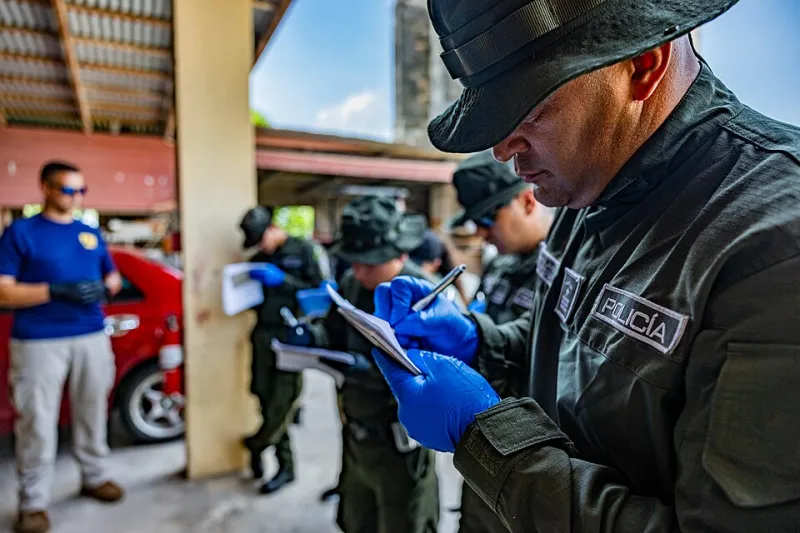
Photo: U.S. Army photo by Sgt. Joshua Taeckens, Public domain, via Wikimedia Commons
At some point in the last decade, the true crime documentary ceased to be a niche interest and became a dominant cultural form. Netflix's Making a Murderer arrived in 2015 and demonstrated, with uncomfortable clarity, how completely an audience could be captured by real human suffering when it was structured like a thriller. What followed was not simply a genre boom. It was the industrialization of grief.
Today, the true crime documentary is one of American streaming's most reliable content categories. New entries arrive weekly. Podcast crossovers are common. Social media communities form around active cases. And somewhere in the architecture of all this engagement, actual victims — actual people who experienced actual violence — have become the raw material for a form of entertainment that struggles to acknowledge what it is.
The Grammar of Catastrophe
What the true crime documentary does exceptionally well is apply narrative structure to events that, in reality, have no narrative logic. Real crimes are messy. Evidence is incomplete. Motivations are often banal or incoherent. Justice, when it arrives, rarely feels proportionate. The experience of those closest to violence is rarely reducible to a three-act arc.
The documentary form corrects for all of this. It selects. It sequences. It scores. It chooses which voices to amplify and which details to withhold, building toward revelations that are engineered to feel earned. The result is a story with the emotional satisfactions of fiction — tension, release, catharsis — attached to the moral weight of actual events.
This combination is extraordinarily powerful. It is also, on examination, extraordinarily strange. We are being asked to experience aesthetic pleasure from the documentation of someone's worst moment. The documentary's craft — its editing rhythms, its atmospheric cinematography, its strategic use of silence — exists to make that pleasure feel legitimate.
Rooting for Clarity Over Justice
One of the most revealing aspects of true crime consumption is what audiences actually want from it, which is often not justice in any robust sense but resolution. The comments sections of true crime communities are full of viewers who feel personally aggrieved when a case remains unsolved, not because they have any stake in the outcome but because an unresolved case violates the genre's implicit promise.
This preference for clarity over justice is not neutral. It shapes how documentaries are made. Cases are selected partly for their narrative tidiness — the satisfying villain, the exonerating twist, the systemic failure that can be dramatized in four episodes. Cases that resist clean interpretation are less likely to be produced, which means the true crime genre, in aggregate, presents a distorted portrait of how violence actually operates in American life.
The audience, trained by years of genre consumption, arrives at each new documentary with expectations calibrated by fiction. When the evidence is ambiguous, frustration follows. When the guilty party is obvious from the first episode, the pleasure is diminished. The viewer has become a connoisseur of catastrophe, and real events are evaluated on aesthetic grounds.
The Victim as Character
Perhaps the most morally fraught dimension of the true crime documentary is how it handles victims. The better productions are careful here, centering survivor testimony and avoiding gratuitous reconstruction of violence. But even the most conscientious documentary faces a structural problem: to make a victim's suffering narratively meaningful, it must make them a character.
Characters are simplified. They are given defining traits, story functions, symbolic weight. They exist in relation to the narrative rather than independent of it. A real person, however — a person who was harmed, who had a life before and sometimes after the event being documented — cannot be fully contained by a character function without something essential being lost.
The true crime documentary almost always loses something essential. The victim becomes the inciting incident, the emotional anchor, the moral justification for the viewer's engagement. Their actual complexity, their life outside the crime, their preferences about how they are represented — these considerations are secondary to the story's needs.
Families of victims have spoken publicly about watching their loved ones transformed into content. Their accounts are not uniformly negative — some have found the documentaries valuable in ways that surprised them — but the recurring theme is the loss of control, the sense that the story has been taken from them and given to strangers who consume it as entertainment.
The Parasocial Investigator
The true crime boom has also produced a secondary phenomenon: the amateur investigator. Online communities devoted to active cases have grown dramatically, and their members frequently describe their participation in terms that blur the line between civic engagement and entertainment consumption. They are solving something. They are helping.
Law enforcement agencies and legal scholars have documented cases in which this amateur engagement has compromised actual investigations, harassed innocent parties, or generated such volume of noise that meaningful signals were lost. The parasocial investigator, energized by the genre's implicit promise that ordinary viewers can crack what professionals missed, enters real situations with the confidence of a fictional detective and the accountability of none.
This is the true crime documentary's most concrete harm: it does not merely encourage passive consumption of real suffering. It actively trains audiences to treat real suffering as a puzzle they are entitled to solve.
What We Owe the Genre and What We Owe the Dead
None of this is to argue that the true crime documentary is without value. At its best — The Jinx, Evil Genius, the Serial podcast that preceded the visual form — the genre has exposed genuine injustice, challenged prosecutorial misconduct, and given voice to people the justice system had discarded. These are not trivial achievements.
But value and cost can coexist. And the cost of the true crime documentary — paid by victims' families, by wrongly accused individuals whose lives are repeatedly relitigated for new audiences, by the culture's capacity to distinguish between justice and entertainment — is rarely part of the conversation that happens around it.
We have built a ritual out of other people's worst days. We have subscribed to it, recommended it, discussed it over dinner. The question the genre consistently declines to ask is the one that most urgently needs answering: what do we actually owe the people whose suffering we are consuming, and have we ever seriously tried to pay it?