Inside the Unforgivable: How Villain-Centered Narratives Force Us to Inhabit the Minds We Most Fear
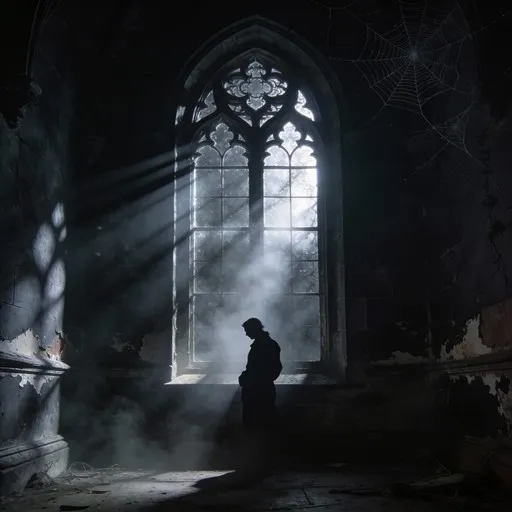
Photo: dark shadowy figure silhouette looking through glass window dramatic lighting, via images.stockcake.com
There is a particular discomfort that arrives not from watching a villain commit an atrocity, but from understanding, with uncomfortable precision, why they believed it was the right thing to do. Contemporary storytelling has grown increasingly fluent in manufacturing that discomfort. It does so not through spectacle or shock, but through proximity—through the sustained, almost suffocating choice to remain inside a perpetrator's perspective long after the audience has every reason to want out.
This is not the same as sympathy. The distinction matters enormously, and the best of these works understand it completely. To inhabit a mind is not to excuse it. But the narrative architecture required to sustain a villain's point of view—the first-person voice, the unbroken camera position, the interiority granted to those who have forfeited any moral claim to our attention—creates a form of complicity that lingers well past the final page or the closing credits. The story has made us witnesses from the inside. And inside, there is no clean place to stand.
The Grammar of Perpetration
Literary fiction has long understood that the first-person confession is among the most destabilizing structures available to a writer. Vladimir Nabokov's Lolita remains the most discussed example in American literary culture, and for good reason—its narrator is charming, erudite, and engaged in the systematic destruction of a child. The novel never abandons Humbert Humbert's voice. It never offers a corrective perspective to neutralize his self-serving eloquence. Nabokov forces readers to do the corrective work themselves, to supply the moral counterweight the text withholds. Decades later, that demand still unsettles readers who expected the story to do their ethical labor for them.
More recent works have extended this grammar into film and television with increasing sophistication. The camera, when trained exclusively on a perpetrator's experience, functions as a first-person voice made visual. It does not simply show us what the character does—it shows us what the character sees, and crucially, what they choose not to see. That selective vision is where the real horror lives.
Unreliable Narration as Ethical Trap
Unreliable narration is often discussed as a craft technique, a clever mechanism for generating plot twists or thematic irony. In villain-centered storytelling, however, it operates as something far more troubling: an ethical trap. The audience is given access to a consciousness that is actively misrepresenting reality, and the story does not always provide the tools necessary to detect the misrepresentation in real time.
Gillian Flynn's work in American fiction offers a compelling case study. Gone Girl's Amy Dunne narrates her own story with such precision, such apparent self-awareness, that readers frequently find themselves nodding along before the architecture of her perspective is fully revealed. The unreliability is not random—it is strategic, curated, and deeply self-serving. Flynn's achievement is that she makes the audience feel the seduction of Amy's logic before exposing it as a performance of control. By the time the trap closes, the reader has already been inside it for a hundred pages.
Film adaptations of such material face a different challenge. David Fincher's 2014 adaptation of Gone Girl had to translate an interior voice into visual grammar without losing the claustrophobic intimacy of Amy's narration. The solution—extended voiceover married to a camera that lingers on Rosamund Pike's composed, unreadable face—creates a version of the same trap. We watch someone perform interiority. We cannot verify what lies beneath the performance. And yet we keep watching, because the alternative is to admit we have no access at all.
The Camera That Will Not Look Away
Among the most formally rigorous examples of sustained perpetrator perspective in recent American cinema is Nightcrawler (2014), in which Jake Gyllenhaal's Lou Bloom is never abandoned by the frame. The film offers no refuge—no cutaway to a character who sees Lou clearly, no narrative voice that contextualizes his escalating predation. The audience is given Lou's ambition, Lou's logic, Lou's sense of justified entitlement, and nothing else. The film's horror is not that Lou is incomprehensible. It is that he is entirely comprehensible—and that his comprehensibility implicates the economic and media structures that reward him.
This is the deeper function of villain-centered perspective at its most artistically rigorous: it does not ask us to understand the monster as exceptional. It asks us to recognize the monster as a product of systems we already inhabit. Lou Bloom is not alien. He is American capitalism's most honest practitioner. The camera's refusal to look away is not cruelty toward the audience—it is insistence that the audience not look away from itself.
Complicity as a Narrative Instrument
The question of whether forced proximity to a villain's perspective constitutes artistic cruelty or necessary empathy may be, in the end, a false binary. The most effective works in this mode do not ask for empathy in the conventional sense. They do not request that we feel warmly toward the perpetrator or excuse the harm they cause. What they demand is something more uncomfortable: that we remain present, that we follow the logic, that we do not retreat into the safety of pure condemnation before the story has finished making its case.
That demand can be weaponized irresponsibly. There is a meaningful difference between a narrative that uses villain perspective to illuminate structural evil and one that simply aestheticizes a perpetrator's experience for the pleasure of transgression. The former earns its discomfort. The latter merely produces it.
The test, perhaps, is whether the story changes what the audience understands about the world they live in, or only what they feel during the two hours they spend inside the theater. A villain's perspective that reveals nothing beyond its own cleverness is a formal exercise masquerading as an ethical one. A villain's perspective that forces genuine reckoning—with complicity, with the seductions of self-justifying logic, with the systems that produce and reward certain kinds of predation—is among the most valuable things storytelling can do.
What We Carry Out
The experience of exiting a villain-centered narrative is unlike most other encounters with difficult art. The discomfort does not stay behind with the story. It travels with the audience, because the audience has been made a temporary resident of a consciousness they cannot entirely disown. The intimacy was real, even if the intimacy was with something they would never choose to be near under ordinary circumstances.
This is what the best of these works understand about their own project. They are not asking audiences to forgive the unforgivable. They are asking audiences to acknowledge that the unforgivable is not as distant as we prefer to believe—that the grammar of self-justification is fluent in all of us, that the mechanisms of harm are rarely as alien as we need them to be. The villain's perspective, held long enough and rendered with enough honesty, becomes a mirror. What reflects back is not the monster. It is the architecture of thought that makes monsters possible—and the uncomfortable recognition that we already know our way around that architecture far better than we would like to admit.